Why Less Educated Founders Often Win in India: What Basesh Gala Says
Described in the episode as having trained about 10 lakh people, helped around 2500 companies, taken 16 companies to IPO in the last year and a half, and running retail stores of his own. Those are his claims.
The 10th pass businessman often owns the shop, and the MBA graduate often works inside it. Is that luck, or is there a pattern? Business coach Basesh Gala tells Sarvesh Mishra on The Sarvesh Mishra Show that it is a pattern, and it has more to do with hunger than marks.
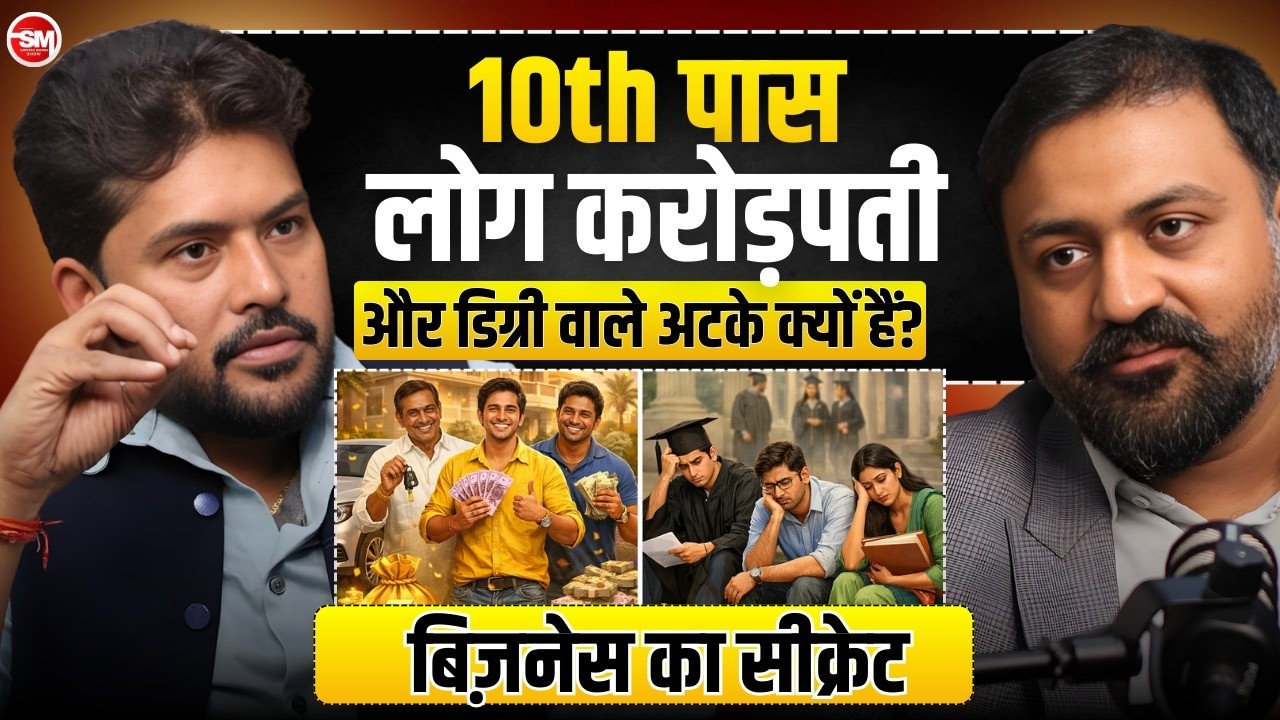
बिना Degree के ₹1 Crore कमाने का Formula | 10th Pass Business Secret 2026 @BaseshGala · 62 min 25 sec
This guide explains business without a degree in India in plain words, and adds what research says so you see both sides. Everything attributed to the guest is his own view. Who is this for? Students, job holders, small shop owners and first-time founders who are deciding whether to start a business now, later or never.
Why less educated founders often win: three reasons
| Reason | What he says |
|---|---|
| Early success creates ego | People who win early stop working hard and struggle with failure. He gave cricketer Vinod Kambli as an example. |
| High IQ, low team skills | Very bright people often think “I can do it myself” and find it hard to build a team. |
| Hunger | People who struggled early stay hungry and say “I don’t know, teach me.” |
His summary: it does not matter how educated you are, it matters how hungry and curious you are.
Founder hunger and mindset
Gala says founders who admit what they do not know tend to hire experts and learn from everyone, even the peon, who often knows what vendors, customers and staff really say. He also believes free food and housing schemes have reduced the pressure to struggle. He cited a survey claiming 75 percent of Indians would not work if they did not have to, and said he sleeps about three hours a night to code his own AI tool so that he is not left behind. Treat that survey as his citation, not a verified finding on this page.
Do you need a degree to start a business? What the data says
No degree is legally required to start a business. But honest reading means looking at both sides. A July 2026 study from the Association of American Universities reportedly found that most founders of billion-dollar startups are significantly more educated than the general population. A 2025 Crunchbase News analysis also examines the gap between the brilliant dropout story and actual education patterns.
How does this fit Gala’s view? He is not saying education is useless. His point is that among ordinary Indian businesses, hunger, humility and risk appetite explain success better than marks. Both can be true: top tech startups may favour highly educated founders, while traders, shop owners and small manufacturers with little schooling often build large businesses through grit and teamwork. For the education-system side of the degree debate, read N.P. Singh on whether your degree is really useless.
The college dropout founders myth
Many viewers quote Bill Gates and Mark Zuckerberg. Gala’s reply: do not use dropouts as an excuse to skip learning. Those founders first proved themselves by getting into top colleges. His challenge is to prove you can get into a top institute, prove you can build something big, and only then think about leaving.
Skill and network beat degrees
Gala expects companies to ask for proof, not just a college degree. If you want to do digital marketing, show your own page and videos. If you claim to know AI, build something in two hours. His rule: skill and network matter most.
Real examples of successful entrepreneurs without a degree in India
Gala gave these examples. They are his claims, so verify details before quoting.
- Radhakishan Damani of DMart: described as not highly educated, and praised for sharing company shares with long-serving vendors and team members.
- Ashok Shah of V Trans: described as having limited formal education, yet he designed an ERP system for his logistics company and built it past 2000 crore turnover.
- A tyre puncture repairer turned founder: now leads an 8000 crore company and still lifts sacks himself when needed, according to Gala.
Business or job? The five traits test
Gala says the “quit your job and start a business” advice has done damage. Check these five traits first.
| Trait | What it means |
|---|---|
| Heart attack capacity | Handle daily stress for the first three to four years |
| Ego free attitude | Take criticism and apologise when needed |
| Risk appetite | Most founders have put home or savings at stake |
| Team player | Think like a captain who builds a team |
| Share success | Share wealth and credit with those who helped you grow |
The Hanuman model for employees
If business is not for you, Gala suggests becoming so valuable that the company cannot run without you, with salary, equity and respect in return. His example is Suraj, who began with tea and cleaning, learned computers in the evenings and now manages a large retail store as general manager, with profit sharing in writing.
The founder trap: Brahma, Vishnu and Shiva mode
| Mode | Role | What happens |
|---|---|---|
| Brahma | Create the business | Works 18 hour days to build |
| Vishnu | Manage with systems and delegation | Business grows beyond the founder |
| Shiva | Destruction | Happens if the founder never delegates |
Many founders get stuck at one to three crore because they sign every cheque and hold the cash counter. His test: if you were taken away for three to six months without a phone, what would happen to your company? In his view, around 90 percent of founders would see it stop, and only about one percent would see it grow.
How to start a business with no money
- Work for one to two years first, unless you have a truly disruptive product.
- Start a side business at night: digital marketing, a website, telecalling, content or an AI service.
- Pick a service business. It needs only a phone, a laptop and internet.
- Learn ethical sales. If you can sell, you can start almost anything.
- Build skill, then network, then funding.
- Give it 1000 days to reach profit and cash flow.
- Reinvest about 90 percent of early profits into team, systems and marketing.
For starter ideas with little capital, see Kartik Dhiman on small business ideas under 50,000 and Ashish Agarwal on starting with ₹1 lakh.
Systems, clean books and cash flow
Gala says clean books make a company easier to fund. He shared an example of a founder claiming 50 crore turnover while the balance sheet showed 11 crore, which delayed funding by three years. His view is that business means profit and cash flow reaching your bank every month, and valuation alone is not business. Read investor terms carefully before accepting funding.
Three founders he will not work with
| Type | Why |
|---|---|
| Comfort zone founder | Listens but never acts |
| Scattered founder | Does many things with no focus |
| Shortcut founder | Jugaad is fine, fraud is not |
How to choose a business mentor
Check that they run a real business, speak to their old employees and customers, and prefer programs of one to five days over long commitments.
- Hunger and curiosity matter more than marks for most small businesses.
- Early success can create ego, and ego blocks learning.
- Do not use famous dropouts as an excuse to skip education.
- Research shows education still matters in tech, so read both sides.
- Business needs courage, humility, risk appetite, team spirit and generosity.
- Move from Brahma mode to Vishnu mode with systems and delegation.
- Start with a service business, build skill and network, then think about funding.
Frequently asked questions
Why do less educated founders often win in India?
Gala says early success creates ego, very high IQ can reduce team skills and struggle builds hunger.
Do you need a degree to start a business?
No degree is required by law. Gala says skill, hunger and network matter most, but he does not tell people to skip education.
Who are successful entrepreneurs without a degree in India?
Gala names Radhakishan Damani of DMart and Ashok Shah of V Trans. Verify details from reliable sources before quoting.
Is it true that 90 percent of startups fail?
The figure is widely quoted but varies by study. Gala advises protecting cash flow and giving the business about 1000 days.
What age are most successful founders?
There is no single age, and studies differ. Gala suggests working one to two years first. Check a recent source before using a number.
Is the college dropout founders myth true?
Gala says dropouts like Gates and Zuckerberg first proved themselves at top colleges, and recent research suggests most billion-dollar startup founders are highly educated.
What is the best way to start a business with no money?
A service business such as digital marketing, AI consulting or software services.
Should I do a job or start a business?
He suggests working for one to two years, then trying a side business before quitting.
How can I contact Basesh Gala?
He said Instagram and YouTube are best, and he goes live on YouTube every Thursday at 10 PM. His site is baseshgala.com.
Is this financial advice?
No. These are one guest’s views. Speak to a qualified advisor before taking financial risk.
Watch the full conversation
According to Basesh Gala, degrees are not the problem. Hunger, humility and the courage to take risks often matter more than marks when you build an ordinary Indian business. Research adds balance: studies of billion-dollar startups suggest education still matters in tech, and famous dropouts usually proved themselves first. So do not use a missing degree as an excuse.
To build a business without a degree in India, work for a year or two, build a skill, start a service business on the side and learn ethical sales. Then build systems, keep clean books and give yourself about 1000 days. Your degree may open the door, but hunger and discipline decide how far you go.
बिना Degree के ₹1 Crore कमाने का Formula | 10th Pass Business Secret 2026 @BaseshGala
Follow Basesh Gala at baseshgala.com.